
Stop Forcing Shoppers to Act Like Search Engines: Why Discovery UX Fails Undecided Buyers
Traditional ecommerce search breaks down when shoppers have open ended, real world needs instead of exact product names. By replacing rigid filters with conversational, intent driven AI, online stores can guide undecided shoppers, build trust, and capture lost sales.


For years, commerce platforms have relied on the same rigid mechanics: keyword matching, category hierarchies, and an endless array of multi select filters. But customer behavior has fundamentally evolved.
If your store forces shoppers to act like search engines just to find a product, you’re losing sales before they even reach the cart.
The Intent Gap: Known Items vs. Open Ended Browsing
Traditional search interfaces excel at one specific job: known item lookup.
If a customer knows they want ‘Men’s Running Shoes > Size 10 > Black,’ standard filters and dropdowns get them there efficiently.
But what happens when they don’t know their exact specs? What happens when they shop in scenarios, occasions, and trends?
They leave. Even after 20+ years of e-commerce optimization, more than 90% of site visitors bounce without buying a single item because our stores still can’t answer open ended human needs.
*Shopper Thinking: “I’m going camping in Austria next weekend, what gear do I need?”
Legacy Search UI: [0 Results Found] OR [480 Unrelated Flashlights & Tents]*
When an undecided shopper arrives with an open goal or a complex real world context:
Keywords fail because human intent can’t always be condensed into two isolated words.
Filters fail because a customer can’t filter by “cozy outfit for an autumn outdoor weekend” or “shoes suitable for London rain under $150.”
Manual labor increases, driving shoppers away.
In our experience at vviinn, over 70% of shoppers abandon their search when discovery turns into a manual filtering chore.
Conversational Shoppers Don’t Want Speed. They Want Certainty.
Amazon’s shopping assistant Rufus offers a rare look at how people shop when they can ask questions.
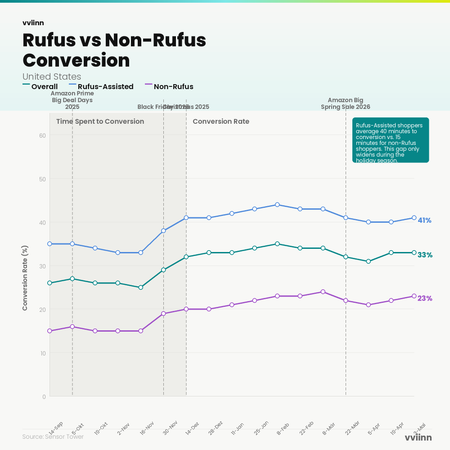
Conversion rate of Rufus-assisted vs. non-Rufus shoppers in the US, September 2025 to May 2026. Source: Sensor Tower
What surprises here is dwell time: Rufus users take about 40 minutes to buy, while everyone else takes 15 minutes on average.
This flips a common belief. AI in commerce is often sold as a shortcut. But these shoppers don’t want a shortcut. They want to ask questions, compare trade-offs, and be sure they are making the right choice. This conversation is where trust is built.
So who are these shoppers? Some may have been ready to buy anyway. But there is a second reading: many of them are the 70% of undecided shoppers who typically abandon complex filter menus. Without someone to ask, they might have left with nothing in their carts. Shoppers looking for certainty take their time to decide and they buy at their own pace.
Build Discovery That Thinks Like Your Customers
Filters and categories will always have a place for surgical, known item lookups. But if you want to capture the massive segment of shoppers seeking solutions, inspiration, and context, your search interface needs an upgrade.
Stop forcing shoppers to act like search engines. Listen to your customers as they take their time to decide what to buy.
Related Posts

Joining Forces for Conversational Commerce: Announcing Our Solution with moinAI
